
SiFT SMART FARMING · OPERATOR INTERFACE
Your farm on a PC.
Your decisions in your hand.
Bring crop conditions, tractor work, harvest planning and buyer commitments into one proposed operator experience for the SiFT Smart Demonstration Farm.
DESKTOP OVERVIEW. PHONE ACCESS.
One shared picture of the farm.
Farmer benefits · Marketing & sales · Research evidence · Measure performance
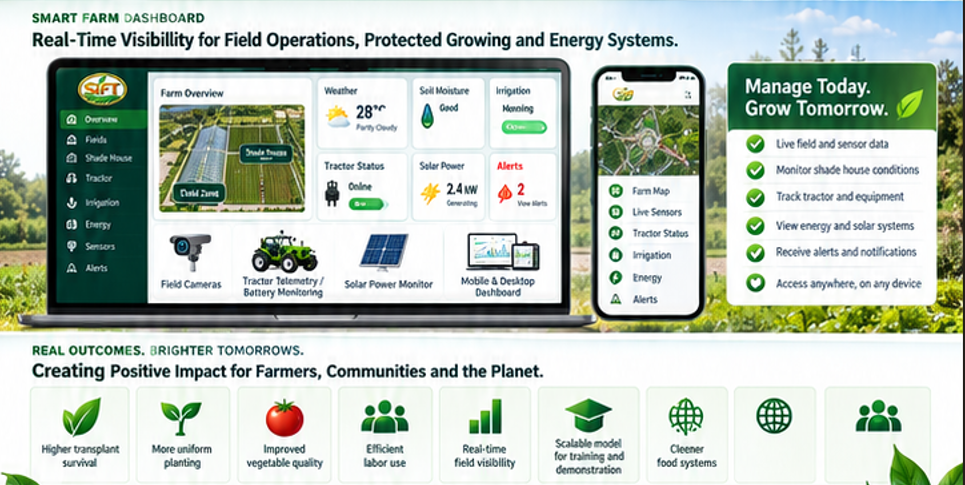
PC · PLAN AND COMPARE
The whole operation, side by side.
The proposed desktop workspace combines the farm map, zone trends, irrigation records, tractor utilization and harvest commitments. A manager could compare crop batches, allocate work, review costs and prepare buyer availability reports without switching between disconnected records.
PHONE · CHECK AND RECORD
Useful information beside the crop.
The proposed phone view prioritizes assigned tasks, alerts, zone readings and tractor status. Field staff could record observations, crop photographs, harvest weights and completed jobs at the point of work. Offline entry and later synchronization are design requirements, not enabled features of this website.
BENEFITS FOR THE FARMER
Turn observations into timely work.
The value is not the screen alone. It is the sequence: measure a condition, interpret it, assign a response, verify the work and record the result. These proposed workflows are designed to support the farmer rather than replace field judgment.
Prioritize crop attention
Compare moisture, temperature and humidity by zone. Display reading age and sensor faults alongside alerts, then send a person to verify unusual conditions before deciding on an intervention.
Keep batches traceable
Connect seed lot, nursery tray, transplant date, growing bed and harvest lot. Track germination, rejected transplants and establishment so the next planting cycle can use lessons from the last.
Coordinate people and support
Assign responsibility, due time and completion evidence to each job. Share selected records with an agronomist or technician. Training, clear handovers and usable local-language instructions should accompany deployment.
MARKETING + SALES
Plan what to grow around what buyers need.
For this demonstration, the commercial design should cover two distinct offers: vegetable transplants from the nursery and harvested tomatoes, cucumbers and bell peppers from protected production. Outdoor crops can be added to the same availability plan.
MARKETING · BUILD CONFIDENCE
Show availability with evidence.
A proposed buyer-facing availability sheet would show crop or transplant variety, expected readiness window, estimated quantity, grade and pack size. Date-stamped crop photographs and batch records would support conversations with restaurants, retailers, cooperatives and neighboring growers.
Keep estimates separate from confirmed stock. Share only approved information; do not expose worker records, farm security details or private buyer prices. Environmental and quality claims should be supported by measurements, not inferred from having sensors.
SALES · FOLLOW THROUGH
Connect orders to harvest and delivery.
The proposed sales workflow links an inquiry to a quotation, reservation, harvest allocation, dispatch record, invoice and payment status. Record agreed grade, volume and delivery window; check stock before accepting an order to limit double-booking.
Compare buyers using the price actually received after grading losses, packing, transport and selling fees. Monitor repeat orders, rejected deliveries and unpaid balances. Payment processing and accounting connections require separate approved integrations.
EFFICIENCY + SiFT EQUIPMENT
Make every job, drop and charging session count.
Water and protected growing
Review irrigation volume beside root-zone measurements and crop stage. Compare the propagation and fruiting-crop zones separately. Log roof and irrigation events through approved interfaces; sensor placement, calibration and crop-specific settings determine whether the information is useful.
Tractor work and labor
Plan bed preparation, operator-supervised transplanting, cultivation and produce movement as connected jobs. Record the operator, implement, area, time, planting checks and energy used. Coordinate nursery readiness with tractor availability to avoid moving plants before the field is ready.
Energy and maintenance
Use approved battery and operating-hour data to plan charging and maintenance. Compare measured solar generation with charging demand; a sunny icon is not an energy budget. Separate productive work from waiting, rework and downtime to identify where operating routines need attention.
A WORKDAY ON THE DEMONSTRATION FARM
From the morning check to tomorrow’s orders.
Morning: review the age and quality of sensor readings, inspect flagged zones and confirm today’s nursery batches, field tasks and buyer commitments. During work: operators log planting checks, irrigation observations, harvested quantities and equipment exceptions on their phones. End of day: the manager reconciles stock, deliveries, labor and energy on the PC, then updates the next day’s work plan and buyer availability.
The planning basis is a one-hectare farm with a one-acre Cravo house: half for vegetable-transplant propagation and half for tomatoes, cucumbers and bell peppers. Keep separate records for both protected zones and the outdoor beds. Gross zone area includes aisles and services; use actual bench or cropped area when comparing productivity.
RESEARCH DATA · EXTERNAL STUDIES, NOT SiFT RESULTS
What measured performance improvements look like.
Published research provides examples of gains from irrigation decision support, sensor-controlled equipment and better market information. The results below use different crops, locations, comparisons and interventions. They cannot be added together or treated as a forecast for this farm, this interface, Cravo or SiFT equipment.
[1] IRRIGATION APPLICATION · GEORGIA, USA
13% higher yield; 44% less irrigation water
UGA’s 2019 research report describes five years of cotton-app studies averaging these differences against its Extension calendar/checkbook scheduling method.
Relevance: timely irrigation advice can connect weather information to practical action. Limit: these are cotton results against a specific baseline, not a measured effect for greenhouse vegetables or the SiFT application.
[2] TOMATO IRRIGATION EQUIPMENT · FLORIDA, USA
40–50% less irrigation, without reduced yield
UF/IFAS summarizes a tomato study in which switching tensiometers controlled drip irrigation on fine sandy soil, reducing irrigation requirements by 40–50% without reducing yield.
Relevance: soil feedback can improve water productivity even when yield does not increase. Limit: soil type, sensor response, placement, calibration and the original watering schedule matter; the percentage is not a universal saving.
[3] SENSOR-CONTROLLED NURSERY · GEORGIA, USA
50% lower crop losses; faster time to sale
In its summary of Lichtenberg, Majsztrik and Saavoss’s 2013 gardenia study, ASHS reports 50% lower crop losses and a reduction of more than one-third in weighted average time from planting to sale under moisture-sensor-controlled irrigation.
Relevance: nursery performance includes saleable plants and space turnover, not just water use. Limit: this was an ornamental gardenia nursery, not vegetable-transplant propagation in a Cravo house.
[4] MOBILE ADVICE · KENYA
11.5% initial yield gain; no significant gain in a follow-up
IPA’s 2019 summary reports that SMS agronomic advice raised yields by 11.5% against a no-message control in an initial smallholder sugarcane trial. It also reports that a follow-up trial of the same intervention did not significantly affect yields.
Relevance: reminders may help close information gaps. Limit: advice, training, farmer engagement and context determine effectiveness; a phone interface does not guarantee a yield response.
Innovations for Poverty Action: Harnessing ICT, 2019 summary
[5] HORTICULTURAL MARKET INTELLIGENCE · UGANDA
20–25% higher production revenues
An August 2026 IFPRI discussion paper reports a cluster-randomized evaluation of a bundled, market-oriented horticulture intervention in northern Uganda. Treated farmers increased production revenues by 20–25%, profit margins by about 11 percentage points and received prices by roughly 20%, without increasing family labor.
Relevance: buyer knowledge belongs beside production planning. Limit: this internally reviewed working paper evaluates market-intelligence support plus production support—not a standalone app or a proven SiFT sales effect.
Takeshima, Maruyama & Yamauchi, IFPRI Discussion Paper 2435, 2026
[6] DIGITAL BUYER–SELLER MATCHING · UGANDA
6% more trade between treated markets
A large-scale platform experiment, interpreted through a trade model in NBER Working Paper 33221, estimated a 21% reduction in fixed trade costs and a 6% increase in trade flows between treated markets.
Relevance: market connections can complement crop records. Limit: engagement was largely by bigger traders, with limited farmer use. These are market-level estimates, not a 6% promise for an individual farmer’s sales or profit.
Bergquist, McIntosh & Startz, NBER Working Paper 33221, 2024
MEASURE THE SiFT FARM’S OWN RESULTS
A performance record, not a blanket promise.
The demonstration should test the combined system and, where practical, its individual components. Use matched crop varieties, planting dates and management conditions; randomize comparable beds or nursery batches where feasible. Measure conventional practice alongside the new workflow over complete crop cycles, repeat in more than one cycle, and record weather and management changes.
Crop and nursery performance
Measure saleable transplants per batch, losses, days to readiness, establishment after planting and marketable harvest weight per cropped square meter. Keep nursery throughput separate from vegetable yield.
Water, labor and equipment
Record total irrigation and liters per kilogram sold, labor hours per 1,000 transplants, tractor hours and kWh per job, downtime and missed tasks. Meter water and energy; do not infer savings from screen readings alone.
Sales and commercial results
Track harvest sold, spoilage, realized price, on-time order fulfillment, repeat purchases and contribution margin. Deduct packing, transport, labor, energy, consumables and selling fees; assess technology ownership and operating costs separately.
Compare like with like: for a metric where higher is better, percentage improvement is 100 × (new result − baseline) ÷ baseline. For water, time or losses, percentage reduction is 100 × (baseline − new result) ÷ baseline. A zero baseline needs an absolute comparison, not a percentage. Report sample size and variability alongside the result.
Count the full cost: include equipment depreciation or annualized ownership cost, application subscriptions, connectivity, calibration, maintenance, training and replacement parts. A before-and-after comparison without a suitable control is descriptive, not proof that the application caused the change.
FROM DEMONSTRATION TO A WORKING APPLICATION
Connect the right data. Keep control accountable.
The proposed chain is sensors and approved equipment interfaces → farm gateway and local records → secure application service → PC and phone views. Seeed’s referenced agriculture solution supports LoRaWAN/4G communications and microclimate, soil and traceability use cases. A separate compatible 5G router is an optional internet connection choice, not a requirement for every sensor. Seeed sensing reference.
Trust the reading
Display the zone, device, units, reading time and quality flag. Mark missing or stale readings clearly; retain local records during outages. Thresholds and recommendations need crop-specific agronomic review.
Protect access and records
Use individual accounts, appropriate roles, secure sign-in, encrypted connections, backups and activity logs. Keep credentials on the server. Give buyers only the product and order information they need.
Keep safety at the farm
Roof protection, pump interlocks and tractor operation must remain under approved local safeguards. Any future remote commands need authorization, confirmation and engineering validation. This public page cannot operate equipment.
EXPLORE THE NEXT STEP
See the demonstration. Define the working system.
Explore the sample dashboard, review connected-device roles or discuss a farmer-centered implementation. The next step is a tested operating workflow and a measured business case—not an unsupported performance guarantee.
Image supplied by the project owner. Research links appear with their corresponding findings above. Sources and image credits. Page reviewed 12 September 2026.